









Sensemaking has always been a useful capability, but it has become a critical capability as we all deal with complexity, ambiguity, volatility, conflicting views, and fast-moving changes. When you are faced with a firehose of data and information, and not all of it is trustworthy, you need to be able to cut through it.
It is an indicator of leadership potential.
Sensemaking, as Hrishikesh Karekar describes it, is the “cognitive and social process of extracting meaning from information and experiences.” I like that they include ‘experiences’ in this description, because they can be an important guide and source of mental models that help you toward usable insights.
Another key element is being willing to abandon your approach or ideas if they aren’t working by testing your understanding of a problem to refine it or start over.
Give up on finding the one true answer
The time where one might arrive at the one true answer is gone, if it ever existed. Sensemaking requires us to make decisions knowing that the inputs at hand will not be clear or straightforward, and relationships between those inputs won’t be easily discovered.
We can lean on experience, but we must take approaches to decision-making that are grounded in the unique context of a specific challenge. In other words, sensemaking requires adaptability, as well as other capabilities such as seeing a bigger picture, recognizing patterns, and seeing connections across different situations and emerging information.
As Jim Moss puts it, you need ways to understand what is actually happening in real time and what it means for how you should act. Or another way to think about it is you are trying to improve the signal-to-noise ratio.
One view on sensemaking
The Cynefin Framework was developed by Dave Snowden based on Complex Adaptive Systems theories. It’s meant to demonstrate to leaders and decision makers that context is critical to navigating complex environments. He believes that there are “multiple, intertwined factors in our environment and our experience that influence us (how we think, interpret and act) in ways we can never fully understand.”
This is the framework:
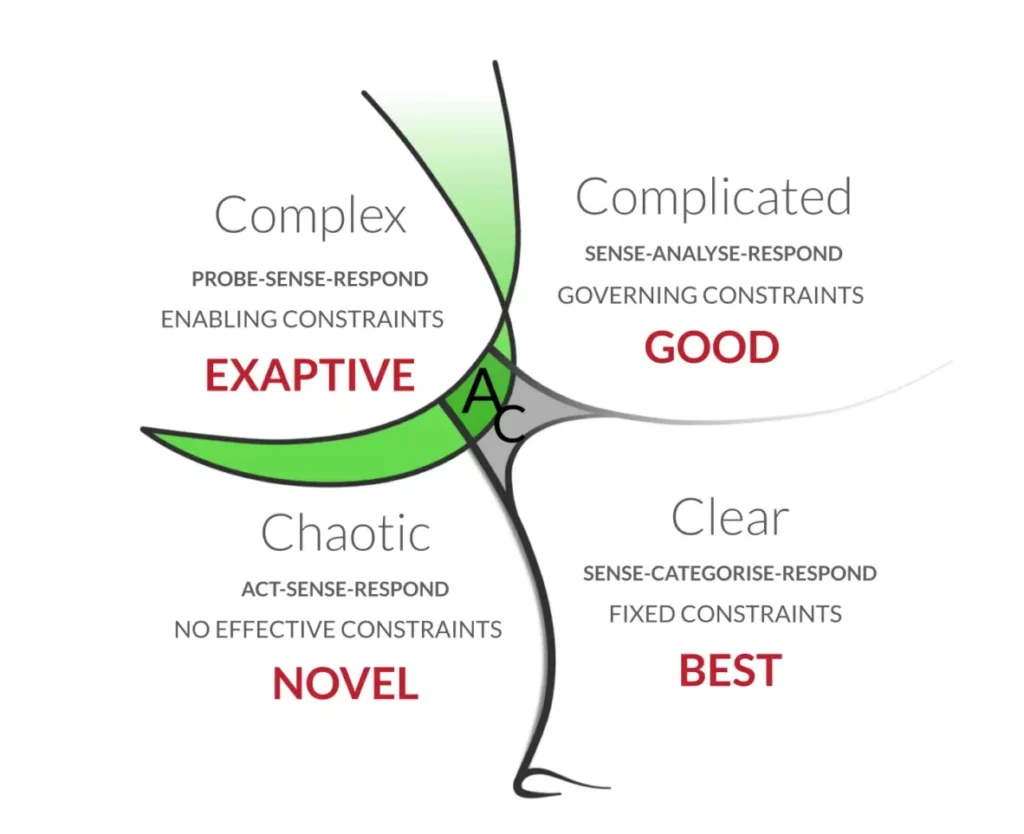
| Domain | Predictability | Examples | Approach |
| Clear | High | Routine compliance checks | Follow best practices; automate |
| Complicated | Medium | IT system failure | Analyze with experts; compare options |
| Complex | Low | Initiatives, experiments, KM | Experiment + learn |
| Chaotic | None | Data breach, financial crisis | Act fast to stabilize, assess, then steer to another domain |
You should view this framework as a sort of pinwheel that aligns actions to type or level of constraints you face. If you can understand which context you have, you can resist overthinking and be better at applying sensemaking in ways that will help.
At the center of the framework, is disorder. This is when you don’t know which domain/category you’re in, so you fall back to your preferred style of decision making and problem solving. If you are in this context, the first step should be to break down the problem into parts and assign them to appropriate domains to help you clarify how to respond.
What does sensemaking look like?
Even without a fancy framework, you can understand why it would be helpful to slow down just enough to get a grip of the situation:
- Talk to people and observe what they are experiencing.
- Don’t rely on dashboards or reports alone.
- Reassess if you are paying attention to the right indicators that are important now instead of relying on the ones you’ve used before.
- Widen the scope of your attention. Sometimes patterns are hard to see when you view a situation in narrow or “tried and true” points of view.
- Interact with new communities that might offer new insights or perspectives that will challenge your thinking.
- Try some unstructured thinking such as a mind map or whiteboard session where you draw or write down all of the elements you know about and then worry about figuring out relationships, themes, and patterns.
Practices for sensemaking
Harold Jarche provides some key practices for sensemaking to which Tanmay Vora added some additional ideas:
- Be curious. About ideas for creativity. About people for empathy.
- Deal with ambiguity. You need to be okay with solving paradoxes and embracing cognitive dilemmas.
- See with several lenses. Actively engage with others and communities of practice to develop a shared understanding and terminology. Broaden your knowledge circles.
- Experiment. Take control of focused learning that will help you to move forward with relatively low risk.
- Share your work. Document and share any emergent practices you have. Ideally, you can learn collectively.
- Prioritize time to reflect and synthesize. Real learning happens when we sit down to reflect on what we experience. Set aside regular time to synthesize and reflect on new information and experiences.
- Embrace slow learning. Slow media like books, well-written blogs and podcasts allow for a more nuanced internal conversation that you will not get from scrolling or social feeds.
- Use AI wisely. You can use AI to stimulate discussions (or apply a framework to a problem), but you should always be thinking about your own learning. Asking the right questions helps a great deal in clarifying concepts and gaining explicit understanding on complex topics.
- Practice critical thinking. Question the sources of information you consume and do some counter-research.
- Consume less, create more. Consuming content can feel like an endless cycle. Creating and writing helps you to build a deeper understanding and to develop better gut instincts.
When sensemaking works, as The Smile CEO’s Jim Moss says, people may struggle to describe how it feels, but it’s not really about being motivated or inspired. Instead, it’s more like, “I knew something was off. I just couldn’t name it.”
If you succeed in figuring out the constraints and character of your problem, then the next step should become obvious. That next step might be to automate a process, to consult an expert, to run an experiment, or to act fast in the moment and then come back to analysis.
You are trying to gain the capability of better judgement. You’ll feel more confident to act and perhaps reduce some of the stress that comes with complex problems.